
(Pause) Period!
Punctuation as Metaphor

It’s been a longish parenthesis of not posting here (apologies!), but punctuation’s back! Or rather, I’m back from my much-needed holidays, and the cold that caught me promptly at the end of my vacation, and work raining down on me... My second book, Points of Contention: A Social History of Punctuation, is finally done y’all! That is, it’s written, and we’re moving into the editing stage, shaping it up into a book that´s nice to read and to look at. It’ll come out in June 2026 in the US, UK, and as a translation in Germany. 🎉🪅🪩
I loved most of my time writing this book, particularly the last four months of extremly intense alone-ness with it, although there were moments of teetering on the brink of burn-out that I certainly don’t care to repeat...ever. Yet, there is no end to thinking about punctuation and all that’s attendant to it like communication-technology, how and why we read, language changes, all things word. So we’ll just keep on keeping on!
And anyway, there’s another little biography of a punctuation mark I can’t stop thinking about, and it’s the one that got me into punctuation in the first place: the bracket. We don´t have a book on brackets yet, although there are other punctuation portraits: Cecila Watson wrote a wonderful celebration of the semicolon (aptly called Semicolon); then there’s On the Dot by Alexander Humez about the period (this book didn’t do it for me as it was more of a show-and-tell rather than explaining and interpreting); and Padgett Powell’s strangely addictive book entirely made up of questions, The Interrogative Mood (A Novel? as the subtitle cheekily asks us). And of course my whimsical biography of the exclamation mark An Admirable Point.

Apart from deep-dives into individual signs (or punctuation history as a whole), some authors have added less-obvious candidates like The Footnote: A Curious History by Anthony Grafton, Space between Words: The Origins of Silent Reading by Paul Saenger, or Index, A History of the by Dennis Duncan. I’ll write about these as we go along! Some of them are more readable than others, and I’ll be your human-ChatGPT and give you summaries-cum-reviews.
As far as I can tell, there is no dedicated book to the comma, the colon, or the bracket. I’m sure there’s a lot one could say about the balancing act performed by a well-placed colon: it’s creating feelings of expectation and apprehension after all, setting us up as it does for a rhythmically rounded sentence. And the comma, I mean! What an under-appreciated workhorse of text! The little hook at the bottom of the line (and pecking order) deserves a whole shelf of books in itself! Yet, it seems to me that a bracket...
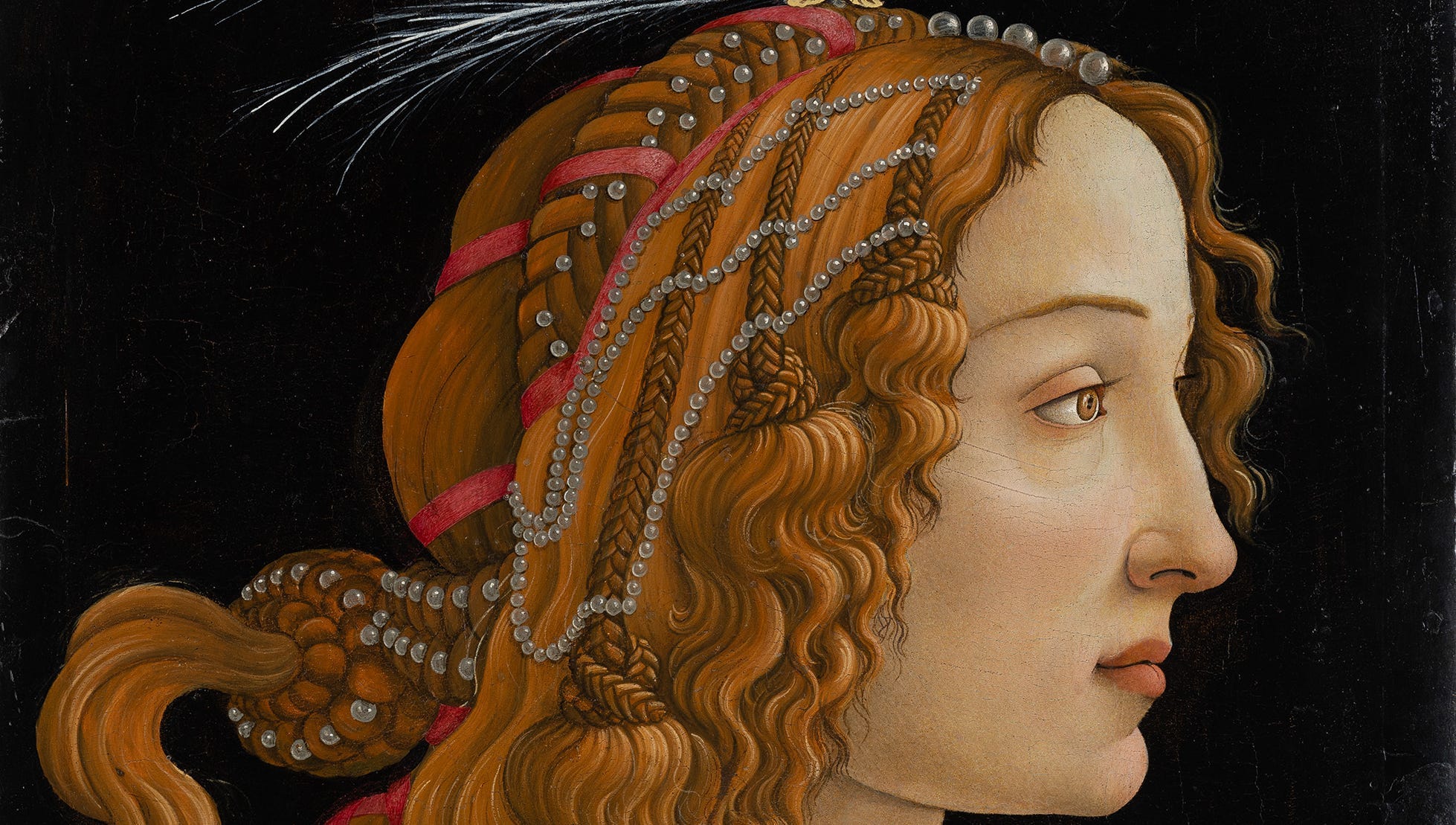
When you put something in brackets in a sentence, you immediately create a highly complex structure: it’s complex both on the level of the sentence which needs to make grammatical room for two parallely running independent lines, and it asks a lot from us cognitively, reader and writer, to construct and process such a twinned sentence. We need to shuttle in and out of the brackets with our eyes and minds, holding onto meaning while also keeping things free enough to continually feedback new information as we go along processing. It’s like weaving a braid where you’ve got to both hold tight and let loose, alternating between different strands of hair while maintaining a firm grip over everything.
Brackets accommodate for complex thought in relation to syntax and content, creating space to wander around within the winding ways of sentence — and grey matter. It needs consummate control and at the same time implies freedom to change your mind, course-correct, qualify, even contradict in ways that are distinctly subversive. Bracket-haters allege it permits unfinished thought to run wild, blurting itself out in a hot verbal mess like blood in a Tarantino-splatter film. Never pretty, always a little bit absurd.
Lovers of brackets, on the other hand, might want to cheer this very provisionality, revelling in the reminder of impermanence this mark seems to offer: nothing, no sentence and no thought, is ever as stable as we might like. Two little halfmoons leaning to the left and to the right have the power to unsettle sequence.
Brackets, I want to suggest, foster this kind of flexible thinking, willing to bend and fold, expand, and digest, where two things can go on at the same time, two things can be true. The punctuation mark nurses a mindset that’s okay with ambiguity and paradox.
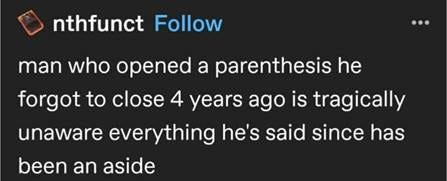
And then, of course, there’s the metaphorical meaning of “bracket“, as in “I’m telling you this as a secret“, often said with a change of voice, a lowered whisper. It’s a hiatus as in pause, as in “let’s put a pin in this and return again after a while”. Yet, you had better specify the conditions of this pause! What are the parameters of the meantime? Friends anybody, Rachel and Ross on a break? Yes, the bracket definitely deserves its own entry in the yearbook of punctuation marks. Until I write that book, here are some musings on punctuation metaphors. What’s a metaphor anyway?

Punctuation Metaphors
We’re getting two-in-one: the period always comes with an exclamation mark. Nobody would say ’I’m done, period.’ It’s always a shouted-out ’period!´and no more discussion, a my way or the high way kinda thing. Americans prefer the term period, Brits full stop. Period comes from the Greek from peri hodos, meaning going around, tracing a full circle, much like the menstruation cycle of course, something that has a beginning and an end. For a long time, a sentence was called “period“ because you completed one full thought in one full rhythm (it’s got to do with the pronunciation of Greek and Latin...don’t ask).
At the beginning of punctuation in Greek-influenced Alexandria over 2000 years ago, a punctuation mark was a stigme; Romans called them distinctio; Shakespeare points or pricks. I have found contradicting dates for the word “period“ in English as a term for the punctuation mark, but language guru Professor David Crystal says 1609, so let’s trust him. It’s still a mystery to me when “period!“ came in, so you’ll have to forgive me for shelving that for now, but Shakespeare’s Merchant of Venice, for example, contains a use of “full stop“ in that sense.
Two citizens of Venice, Solanio and Salarino, exchange news on trade investments by Antonio, the Merchant of the title. Solanio makes a long story of reporting what he’s heard, interrupting himself several times – enough to make Salarino impatiently exclaim ’Come, the full stop’. He wants the gossippy scatter-brained Solanio to reach the long and short of his tale which is that Antonio has lost a ship on the way, making it more and more unlikely that he will be able to pay his debts with Shylock (who has asked for a pound of his flesh upon insolvency). We still say ’full stop’, when we want to close a conversation or prevent further discussion after making a point. It’s more common in the U.K., I think, while period! is a bit of an American thing.

What else can we do with points? We can join the dots, but that’s perhaps more of a paint-by-number metaphor.
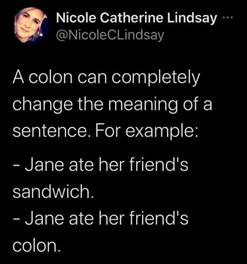
I’m not sure there is an idiom based on a colon punctuation mark, but because we’ve got our colon inside that gave the name to the linguistic colon outside (from the Greek for “member“ as in “limb“ as in “part“ as in “link of a chain“), I want to mention it, and leave this here without comment...
When I want to imply doubt, hesitation, questioning, something left unsaid, I might say “there was a question mark between us“. Is that a metaphor? I’m not sure, but to consider life a sentence is. That’s a metaphor, and it’s been around for at least 400 years (I came across the notion in Sir Philip Sidney’s early novel Arcadia written in the 1580s, but I can’t find the exact quotation). What does that mean? Life is a sentence because it has a beginning and an end. It’s got rhythms, pauses, emphasis, it’s got emotion, themes, questions, exclamations. Are we writing our sentence ourselves, or is it someone else? Something else? Perhaps that’s why the metaphor is so intriguing, because it’s a mixture of both: to some degree, language dictates the contours of a sentence, but syntax is still capacious enough to allow us creativity and self-determination. Maybe life is like that, too? Some things are givens, others not. The degree of those certainties varies depending on your spiritual beliefs.
The metaphor of life as a sentence offers some figurative opportunities for punctuation as well: “death is a comma, not a period“, for example or “where God has put a comma, do not put a full stop“. I’ve come across a combination of these two time and again in a Christian context, and I suppose the understanding is that life continues on the other side of death. Death is but a comma, a momentary pause, the slightest of obstacles which all of us glide over into a kind of never-ending German subordinate clause. A life-sentence in the beyond (couldn´t resist the pun).
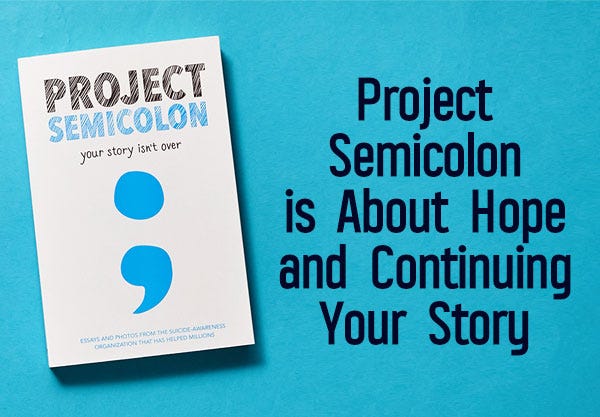
Conceptualising life as a sentence is also as a way of raising awareness for suicide prevention. Amy Bleuel founded Semicolon Project in 2013, ten years after her father’s suicide when she was 18 years old. Picking a semicolon as symbol for the work of the association poignantly plays off the mark’s twinned roots as full stop and comma, combining a somewhat oxymoronic urge pause and go on at the same time. The semicolon can help people who are suffering acknowledge their desire to end their life while also preventing them from doing so by offering an alternative rhythm: pause....and. A semicolon is a beautifully flexible mark that accommodates sentences complete in grammar and content that yet interconnect too much to warrant severing them via full stop. Tragically, Bleuel herself took her own life aged 31. But her legacy continues.

Metaphors we live by
What, in fact, is a metaphor? Well, if you know, hit me up. Because nobody has a sure-fire definition for what they are and how they work, although we know that they do. Work. We’ve got plenty of theories, however, for example this famous one by Cambridge scholar A.I. Richards who explained that the vehicles are the things the metaphor brings into contact somehow (“punctuation“ and “life“ or “suicide“ and “semicolon“). The tenor is the new meaning they create, and the ground is the overlap they share, feeding the tenor. The tenor, for example, is my interpretation on Project Semicolon’s punctuation-as-symbol-choice above. The tenor is not something we can get at just by itself; we need to have those two vehicles merging; we need the ground (the overlap) producing the tenor (the heretofore unheard-of meaning). I know it’s a bit complicated and abstract...
George Lakoff and Mark Johnson published a hugely influential book called Metaphors We Live By in 1980, proposing that metaphors are absolutely everywhere in every language, some more some less visible. “Life is a sentence,“ for example, is an explicit metaphor. We know it’s meant figuratively, not literally. But what about “time is money“? It’s a similarly explicit metaphor, but we’re so used to it that we hardly stop and think what it actually means, what the tenor is, and the ground. More hidden even: the stockmarket goes up. The authors say that’s a metaphor too, although there’s only one noun that combines with a verb and a preposition.
Firstly, stockmarkets can’t “go“ at all. That’s something a living breathing creature with legs does (do spiders go, though? Or only mammals? What about birds?). Secondly, numbers don’t go “up“. They increase, but they don’t literally detach from the screen, and float into the sky. We humans have, over thousands and probably hundreds of thousands, of years established that “up“ means “more“, and “down“ means “less“. Lakoff and Johnson argue that this association comes from our lived experience (hence the title of the book): when we physically pile precious stuff like firewood or food on top of each other, they go up, because they increase. A human being gets older and then grows up. Language is the way it is, because of how we live life.

So if we live by metaphors, then we also live by punctuation. Punctuation-metaphors. It makes sense. It makes sense to say “the holiday was a much-needed bracket in my busy life“, because this metaphor gets to a tenor, a new meaning, we intuitively apprehend much faster than a cumbersome circumscription of how I’ve been working so much, and I need a pause, and.... 🥱
Metaphors, punctuation marks, help us conceptualise experiences, making them graspable, understandable. That’s why my second book is called The Social History of Punctuation: because I’m telling stories about how punctuation came about through the cooperated effort of groups of people, because punctuation has enormous influence over human civilisation, but also because it’s an intrinsic part of our very perception of experience, how we experience experience itself. I could also call the book A Human History, because it’s an exploration of the interaction between people and punctuation: people inventing new marks, and those new marks impacting how people read, write, think, feel, and be with each other.
So while I took a parenthesis-holiday from this newsletter for a while, I’ll leave you with a call to hang in there:
since feeling is first
who pays any attention
to the syntax of things
will never wholly kiss you;wholly to be a fool
while Spring is in the worldmy blood approves,
and kisses are a better fate
than wisdom
lady i swear by all flowers. Don’t cry
—the best gesture of my brain is less than
your eyelids’ flutter which sayswe are for each other: then
laugh, leaning back in my arms
for life’s not a paragraphAnd death i think is no parenthesis
Ahh, e.e.cummings, one of my favourite poets of all time... cummings disagrees with the metaphor of life as a sentence, suggesting it’s far too complex, messy, and wonderful than forcing it into the straightjacket of arbitrary rules. Death is not a comma or parenthesis after which we continue. So, let’s live now!
I guess cummings’ thought here is far more complex than I make it out to be, but it’s spring, and I like to go out now and enjoy the sun, and not pay attentionn to the screen for an afternoon! In a rather pleasing coincidence, cummings published the poem on 16 April 1922, just two weeks (and 103 years) ago. ☀️